A Biography of
Bashirali Currimjee
Third-generation industrialist. Chairman of a house founded in 1890. The man who decided, against the advice of almost everyone, that a small Indian Ocean island should have a mobile telephone network before most of Europe did.
At a Glance
A concise summary of the public record — the essential facts of a career that has run in parallel with the modern economic history of Mauritius.
Why This Life Matters
Business biographies from small states rarely travel. This one does, because the decisions taken in Port Louis in 1989 anticipated by a full decade the mobile-first development model that would later transform economies across Africa and South Asia. Bashirali Currimjee did not follow a proven playbook. He wrote an early draft of one.
- Full Name
- Bashirali Currimjee
- Also Known As
- Bashir Currimjee
- Nationality
- Mauritian
- Principal Role
- Chairman, Currimjee Jeewanjee & Company Limited
- Family Generation
- Third generation of the Currimjee house
- House Founded
- 1890, Port Louis, Mauritius
- Defining Venture
- Emtel — Mauritius' first mobile telecommunications network, launched 1989
- Sectors
- Telecommunications · Media & Technology · Energy · Commerce & Industry · Real Estate · Hospitality · Financial Services
- Base
- Port Louis, Republic of Mauritius
Origins: A Family That Arrived With Nothing but a Trade
The Currimjee story begins not in Mauritius but in Kutch, the arid trading region of western India whose merchant communities had for centuries run commercial networks across the Arabian Sea, down the East African coast and out into the Indian Ocean. Kutchi traders were, by culture and necessity, long-distance people. They understood credit, they understood risk shared across families, and they understood that a merchant house is only as strong as the trust it can command from strangers in distant ports.
In 1890, Currimjee Jeewanjee arrived in Port Louis and opened a general merchandise business. Mauritius at the time was a British colony organised almost entirely around sugar. Its commercial life was dominated by planters, shipping agents and the import houses that supplied a population working the cane fields. Into this ecosystem the new firm inserted itself as a trader: importing textiles, provisions, hardware and household goods, extending credit, and building a reputation for settlement on time.
What distinguished the house from the beginning was patience about reputation. In a small colonial port, commercial standing was the only real collateral. A merchant who honoured obligations through a bad season could borrow through the next one. The Currimjee firm accumulated that standing deliberately across the first generation, and it is the compound interest on that early reputation — not any single transaction — that made everything afterwards possible.
By the time the second generation took over, the business had broadened from pure trading into representation and distribution: acting as the Mauritian agent for international manufacturers, holding stock, managing local logistics and providing the market intelligence that overseas principals could not gather for themselves. This is the environment into which Bashirali Currimjee was born — a household where commerce was not an occupation but a continuous, multi-generational conversation.
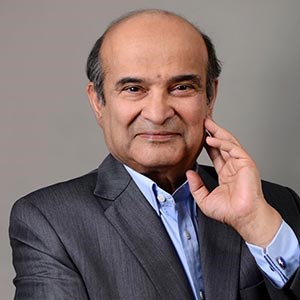
Bashirali Currimjee — inheritor of a merchant tradition that predates the Republic of Mauritius by seventy-eight years.
Context: Mauritius in 1890
A British sugar colony of roughly 370,000 people, connected to the world by mail steamer, with no telephone network, no airport and no independent currency. The distance between that Mauritius and the fibre-connected, high-income service economy of today is the distance this family enterprise has travelled.
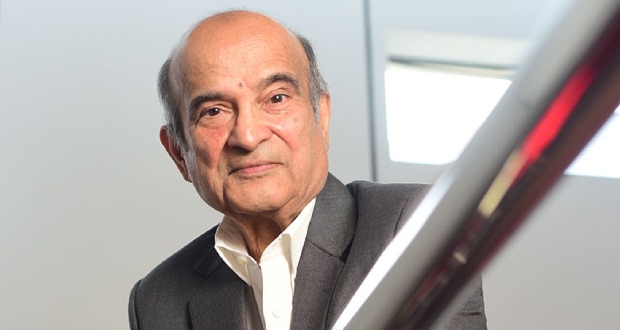
A leader more often described by colleagues as a listener than an orator.
Formation: Learning a Business From the Inside Out
Bashirali Currimjee's education combined schooling in Mauritius with study abroad — a common path for the island's business families of his generation, and one with a specific purpose. Sons were sent out not merely for qualifications but for calibration: to see how commerce was conducted in larger economies, to acquire an international frame of reference, and to return with standards that could be imported alongside goods.
What he brought back was less a set of technical skills than a habit of comparison. Having seen how infrastructure, distribution and consumer markets functioned elsewhere, he was permanently unwilling to accept that Mauritius must make do with less simply because it was small. That refusal — polite, persistent and eventually very expensive to act upon — became the through-line of his career.
His apprenticeship inside the family firm followed the traditional merchant model: no fast-tracking, no ceremonial title. Understanding a distribution business means understanding shipping documents, customs clearance, warehouse turns, credit terms, the psychology of retailers and the seasonality of demand on an island where a cyclone can erase a quarter. That granular, unfashionable knowledge later proved decisive. Telecom infrastructure is, at bottom, a logistics and credit business wearing a technological costume — and he already knew how to run one.
“Smallness is a constraint on scale. It has never been a constraint on standards.”Guiding Principle — Bashirali Currimjee
The Decision That Defined a Career
Every long business life contains one decision that everything before it was preparation for and everything after it was consequence of. For Bashirali Currimjee, that decision was made in the second half of the 1980s.
An Island Waiting for a Line
Fixed telephony in Mauritius was a state monopoly with limited capacity. Waiting lists for a residential connection ran into years. For businesses, communication constraints were a real brake on growth — and for a trading house whose entire model depended on coordination between suppliers, ships, warehouses and retailers, the cost was felt daily.
Leapfrog, Don't Queue
Rather than lobbying for faster expansion of copper lines, he inverted the problem. If laying fixed infrastructure was the bottleneck, then the answer was infrastructure that did not need to be laid. Cellular technology was young, costly and unproven at scale — but it was the only route that could serve the whole island without digging up all of it.
Family Capital, Frontier Risk
There was no venture capital market in Mauritius, no infrastructure fund, no comfortable syndicate to share the downside. The capital came from the house itself. In 1989 Emtel began commercial service, making Mauritius one of the earliest countries in Africa and the Southern Hemisphere to run a cellular network.
Why It Was Genuinely Risky
It is easy, with four decades of hindsight, to read the 1989 launch as obvious. It was not. In the late 1980s a mobile handset cost as much as a small car, battery life was measured in a couple of hours, and the global subscriber base was a rounding error against fixed lines. Serious analysts in far larger markets projected total worldwide mobile penetration in the single-digit percentages.
The Mauritian case looked worse still on paper. A total addressable market of about a million people, most of whom could not conceivably afford a handset; an unproven regulatory environment; and equipment that had to be imported, installed and maintained on an island 2,000 kilometres from the nearest continental landmass. Every conventional financial screen would have rejected the project.
Why It Worked Anyway
The projections were wrong for a reason that is now well understood but was then invisible: mobile is not a substitute for a fixed line, it is a different product. It sells mobility, immediacy and — critically in emerging markets — a service that can be bought in small increments without a credit check or a landlord's permission. Demand did not creep. It compounded.
Mauritius went on to record among the highest mobile penetration rates in Africa, with active subscriptions eventually exceeding the total population. The market Bashirali Currimjee had been told did not exist turned out to be nearly everybody.
The Man Behind the Chairmanship
Bashirali Currimjee has never cultivated the profile of a celebrity businessman. He gives few interviews, avoids the language of disruption, and has consistently redirected attention from himself to the institution he serves. Those who have worked alongside him describe a consistent set of behaviours rather than a set of slogans.
Meetings with the Chairman are, by repeated account, largely interrogative. The pattern is to establish what is actually known versus what is assumed, to test the weakest link in a proposal, and to withhold judgement until the questioning is exhausted. Executives learn quickly that the useful preparation is not a polished narrative but a defensible set of facts.
The merchant inheritance is visible here. In a market of 1.26 million people, a company cannot outrun a bad reputation; there is nowhere to run to. The internal standard has therefore been to treat commitments to customers, suppliers, employees and regulators as obligations that survive changes in commercial convenience.
A founder-dominated company is fragile by design; it inherits the founder's mortality. The deliberate professionalisation of the Group's operating businesses — proper boards, career executives, external audit, and ultimately a public listing for its flagship telecom company — reflects a leader engineering his own dispensability.
Being right too soon is commercially indistinguishable from being wrong, for as long as it lasts. The 1989 telecom decision required tolerating years in which the venture consumed capital and produced scepticism. This tolerance for extended ambiguity is perhaps the rarest trait in the profile, and the least imitable.
The operative question inside the house has never been what a decision does to this year's result, but what condition it leaves the enterprise in for whoever inherits it. That framing changes the answer to almost every capital allocation question — and it is the single clearest cultural difference between a family house and a quoted corporate with a five-year executive tenure.
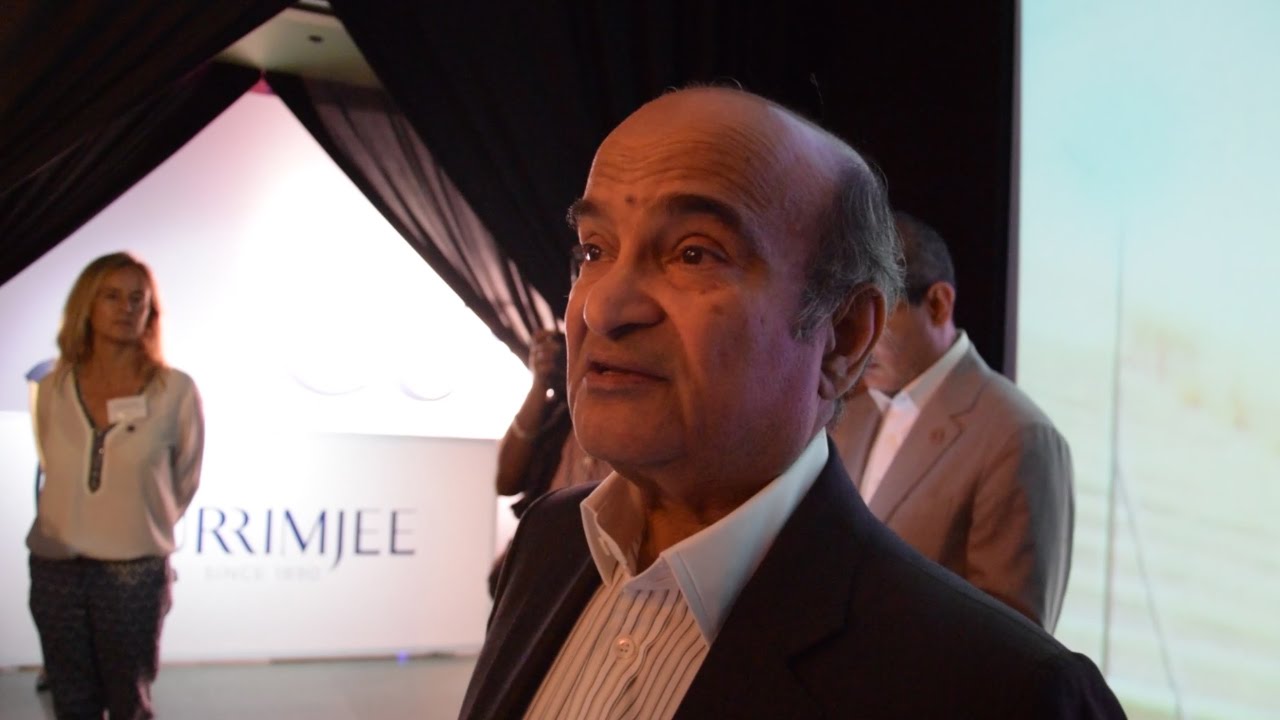
At a Group event — public appearances have been consistently tied to the business rather than to personal profile.
On Succession
The fifth generation of the family is now active within the Group. The transition has been managed the way the rest of the enterprise is managed: gradually, with clear separation between ownership rights and operating authority, and with the expectation that family members earn responsibility in the same way any other executive would.
On Wealth
Bashirali Currimjee is widely counted among the wealthiest individuals in Mauritius. He has consistently treated that standing as a by-product rather than an objective — the arithmetic consequence of holding a productive enterprise for a very long time rather than the purpose for which it was held.
Working Method: How Decisions Get Made
Across four decades the Group's major commitments have followed a recognisable sequence. It is not a formal framework, but it is consistent enough to be described.
-
01
Identify a national gap
The starting question is not "where can we make a margin" but "what does this country lack that someone must eventually build". Businesses entered on this basis begin with demand that is real rather than manufactured, and with a public interest aligned to the commercial one.
-
02
Test whether anyone else will do it
If a capable competitor or the state is already committed, the gap is not the Group's to fill. The opportunities pursued have generally been those that others considered too capital-intensive, too slow-returning or too uncertain.
-
03
Find the international partner, not the international owner
Technology, systems and operating know-how are imported through partnerships with global principals; control and long-term intent remain domestic. This is a deliberate structure — it gives the venture world-standard capability without surrendering the patience that made it possible.
-
04
Underwrite the loss years honestly
Infrastructure businesses lose money before they make it. The commitment is made on the assumption that the loss period is real, budgeted and survivable — not on optimistic projections designed to make an approval easier.
-
05
Professionalise as soon as it works
Once a venture is proven, founder control is progressively replaced by institutional management and formal governance. The objective is a business that continues without the person who started it.
-
06
Reinvest rather than extract
Returns are cycled back into the next national gap. This is why a trading house became a telecom operator, and why a telecom operator's cash flows helped fund energy, property and digital capability.
What the Record Actually Shows
Stripped of ceremony, the biography of Bashirali Currimjee describes a specific and repeatable contribution: he took an inherited trading business with a strong balance sheet and a conservative culture, and he spent its accumulated credibility on infrastructure the country needed and could not otherwise obtain. He then rebuilt the credibility and did it again in adjacent sectors.
That is a rarer achievement than it sounds. Inherited wealth more commonly produces preservation than production. The distinguishing feature of this career is that the inheritance was treated as working capital for national development rather than as an estate to be protected.
A merchant's discipline, an engineer's patience, and an unwillingness to accept that a small country must live with small ambitions.
The House Behind the Man
The biography is only half the story. The other half is the institution — five generations of a single family enterprise, from an 1890 trading counter in Port Louis to a group whose brands reach every household on the island.