1989 – Present

The Signal That
Changed an Island

How Bashirali Currimjee committed a 99-year-old trading house to an unproven technology, gave Mauritius one of Africa's earliest mobile networks, and reset the ceiling of what a Mauritian company was expected to attempt.

Emtel Airbox internet and television service launch event in Mauritius with Currimjee Group executives
The Setting

What Telecommunications Looked Like in 1989

Globally

A Luxury Product for Executives

Mobile telephony existed but had not scaled. Handsets were heavy, expensive and required a car boot or a shoulder strap. Networks were analogue, capacity-constrained and confined largely to major cities in wealthy countries. Total worldwide subscribers numbered in the low millions against hundreds of millions of fixed lines.

In Africa

Almost Entirely Absent

Functioning cellular networks on the African continent could be counted on one hand. The prevailing development view held that mobile was a rich-world technology which would reach Africa decades later, once fixed-line penetration had first been solved through conventional public investment.

In Mauritius

A Waiting List, Not a Network

Fixed telephony was a state-operated monopoly with limited capacity. Households waited years for a connection. Businesses coordinated by telex, fax and physical visit. For an island whose economy ran on trade, tourism and coordination, the communications constraint was a real and daily cost.

The consensus in 1989 was that Mauritius was too small to be an early adopter of anything. The decision taken that year was a rejection of that entire premise.
The Emtel Proposition
The Argument

Four Reasons the Conventional Analysis Was Wrong

The case against a Mauritian mobile network in 1989 was straightforward and, on its own terms, sound. The case for it required rejecting four widely held assumptions.

  1. 01

    “Mobile competes with fixed lines”

    It does not. Mobile sells a different product: personal reachability rather than a location-based connection. In markets where fixed penetration was low, mobile did not cannibalise demand — it created demand that fixed telephony had never addressed.

  2. 02

    “Small markets cannot justify network economics”

    Mauritius is small in population but exceptionally dense and geographically compact. A comparatively modest number of base stations can cover the inhabited island. Network economics depend on subscribers per unit of coverage — and on that measure Mauritius was far more attractive than a sparsely populated continental market.

  3. 03

    “Handsets are unaffordable here”

    True on day one, and irrelevant by year five. Handset costs were on a steep and predictable decline curve driven by global manufacturing scale. Building a network takes years; by the time coverage was complete, device affordability had moved decisively.

  4. 04

    “A trading family cannot run infrastructure”

    Telecom operations are, beneath the technology, a logistics, credit and customer service business — importing and deploying equipment, managing spares and maintenance, billing reliably and collecting from a mass market. The house had been doing exactly that, in a different product category, for ninety-nine years.

Bashirali Currimjee speaking about the Currimjee Group's telecommunications vision in Mauritius

The Chairman has consistently described connectivity as national infrastructure — closer in character to a road network than to a consumer gadget.

The Financing Reality

There was no infrastructure fund, no development finance syndicate and no venture capital market to absorb the risk. The capital came from the family house — meaning that the downside was personal, concentrated and unhedged. This is the detail that most retellings omit and that most explains why nobody else did it first.

The Arc

Four Decades of Network Generations

Infrastructure is never finished. Each technological generation obsoletes the last and demands a further round of capital before the previous round has fully returned.

  1. 1989

    Launch — Analogue Cellular

    Emtel begins commercial mobile service, making Mauritius one of the earliest countries in Africa and the Southern Hemisphere to operate a cellular network. The initial subscriber base is small and overwhelmingly commercial: businesses, professionals and the tourism sector, for whom the productivity gain justifies the cost immediately.

  2. 1990s

    Digital Transition and Mass Market

    The move from analogue to digital GSM technology transforms the economics. Capacity multiplies, call quality improves, handsets shrink and prepaid billing removes the credit barrier that had excluded most households. Mobile ceases to be an executive tool and becomes a mass consumer product. The Mauritian market opens to competition, validating the original bet and forcing the pace of national modernisation.

  3. 2000s

    Data Arrives

    Third-generation networks convert the mobile phone from a voice device into a data terminal. For Mauritius, then actively building a reputation as an offshore financial and business services centre, reliable mobile data ceases to be a convenience and becomes a precondition for the national economic strategy. Penetration rises steeply through the decade.

  4. 2010s

    Broadband, Fibre and Convergence

    Fourth-generation mobile broadband and fibre-to-the-home deployment place high-speed connectivity in ordinary households. Converged offerings bundle internet, television and voice into a single subscription. Mobile subscriptions in Mauritius pass the size of the population — a threshold that would have been considered fantasy at the time of the 1989 launch.

  5. 2020s

    Public Company, Digital Economy

    Emtel Limited is admitted to the Stock Exchange of Mauritius, opening ownership of a strategic national asset to Mauritian savers and institutions. The operator's infrastructure now underpins business process outsourcing, fintech, e-government, remote work and the data services on which the island's next economic phase depends.

Consequences

What the 1989 Decision Actually Produced

The returns on the investment are the least interesting part of the story. The externalities are what make it historically significant.

Universal Access, Two Decades Early

Mauritius achieved near-universal personal communication far sooner than its fixed-line trajectory would have permitted. Mobile subscriptions today exceed the total population, placing the country among the most connected in Africa. An entire generation of Mauritians has never experienced a waiting list for a telephone.

Competition and Liberalisation

A credible private operator changed the political economy of Mauritian telecommunications. It demonstrated that competitive supply was feasible, obliged the incumbent to modernise, and gave regulators a working reference point. Consumers received the benefit in the form of falling prices and rising service quality over the following decades.

The Foundation of a Services Economy

Mauritius' subsequent positioning as a financial centre, a business process outsourcing destination and a regional gateway between Africa, India and Asia is entirely dependent on telecommunications quality. Global clients do not place operations in jurisdictions where the connection drops. That precondition was satisfied because the investment had already been made.

A Change in National Self-Perception

Perhaps the least measurable and most durable consequence. A Mauritian private company had built and operated frontier infrastructure to international standard, in a category the country was supposed to receive rather than pioneer. That precedent altered what subsequent Mauritian entrepreneurs believed was available to them.

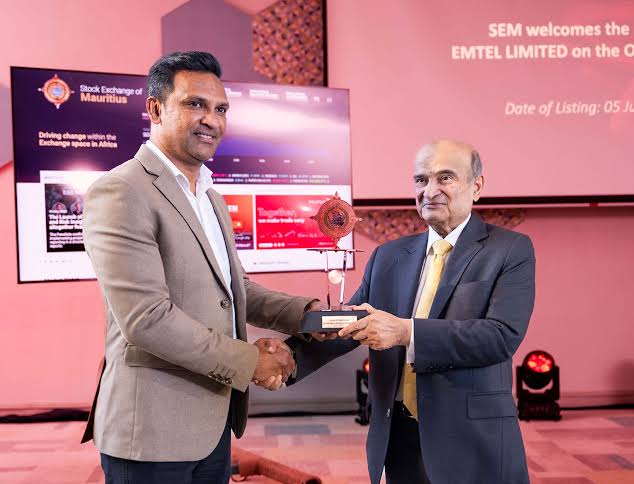
Bashirali Currimjee at the Stock Exchange of Mauritius ceremony marking the listing of Emtel Limited

The listing ceremony — a private family venture formally admitted to public ownership on the Stock Exchange of Mauritius.

Bashirali Currimjee concluding a strategic telecommunications partnership agreement

Strategic partnership signing — international capability, domestic control.

The Threshold

Going Public: The Final Act of Institution-Building

The admission of Emtel Limited to the Stock Exchange of Mauritius closed a loop that had been open since 1989. A venture financed privately by one family, at concentrated personal risk, through years in which its viability was genuinely uncertain, was formally handed over to the public markets.

Listing is often described in financial terms — liquidity, valuation, access to capital. Those matter, but they understate what happened here. A public listing imposes obligations that a private company can decline: continuous disclosure, independent audit, board composition requirements, minority shareholder protections, and the daily judgement of a share price that responds to every operational decision.

Accepting that regime voluntarily is a statement that the business no longer requires the founder's protection. It has its own systems, its own governance and its own institutional standing. In the language Bashirali Currimjee has used throughout his career, it has become an institution rather than a venture.

It also had a distributive effect that fits the Group's stated philosophy. Mauritian pension funds, institutional investors and individual savers gained the ability to own a share of national infrastructure that had previously belonged to one family's balance sheet. The upside of the 1989 risk was, in a meaningful sense, shared with the country that had borne none of it.

DisclosureContinuous public reporting and independent audit
AccountabilityMinority shareholder rights and board scrutiny
ParticipationDomestic savers and institutions able to own the asset
PermanenceA business structurally independent of its founder

Looking Forward

The Same Question, Asked Again

The strategic question facing the Group's telecom cluster today is a restatement of the 1989 question in contemporary terms: what capability will Mauritius need in fifteen years that nobody is currently building?

The candidate answers are visible in the direction of investment. Data capacity, as consumption per subscriber continues to grow at rates that make each network generation obsolete faster than the last. Fibre density, since fixed and mobile networks are converging into a single access infrastructure. Enterprise and cloud services, as Mauritian businesses migrate operations off premises. Machine-to-machine connectivity for logistics, utilities, agriculture and payments. And the security capability that becomes non-negotiable once a national economy is genuinely dependent on its networks.

There is also a strategic layer beyond the domestic market. Mauritius sits at a useful point on the Indian Ocean map, positioned between Africa, India and South-East Asia, with submarine cable landings and a stable legal system. A credible domestic telecom operator is a component of any serious ambition to be a regional digital hub rather than merely a well-connected island.

Whatever the specific answers turn out to be, the method for arriving at them is unchanged. Identify the national gap. Confirm no one else will close it. Import the capability through partnership. Underwrite the loss years honestly. Professionalise once it works. It has produced the right answer at least once before, at a moment when almost everyone qualified to have an opinion held the opposite one.