Leadership &
the Business Empire
A conglomerate is only as coherent as the logic that assembled it. This is the architecture of the Currimjee Group under Bashirali Currimjee's chairmanship — what it owns, how it is governed, and why each part is there.
Not a Portfolio. A Set of National Utilities.
Western corporate orthodoxy has been sceptical of conglomerates for four decades. The argument is well made: investors can diversify a portfolio more cheaply than a management team can, so a group that spans unrelated industries destroys value through complexity and cross-subsidy. In large, liquid, well-served economies, this critique is usually correct.
It transfers poorly to small island states. In an economy of 1.26 million people, most sectors cannot support many competitors. Capital markets are thin. International operators frequently consider the market too small to enter directly. Under those conditions, the diversified domestic group is not an inefficiency — it is often the only entity with the balance sheet, the local knowledge and the patience to build essential capability at all.
This is the frame within which the Currimjee Group must be read. Its clusters were not assembled because they were cheap. They were assembled because Mauritius required each capability and no one else was building it. Telecommunications in 1989. Modern fuel logistics for an import-dependent island. Beverage manufacture at international quality standards. Integrated resort development capable of attracting foreign direct investment. Digital services for an economy pivoting to knowledge work.
The result is a group whose commercial interest and national interest are structurally aligned to an unusual degree — which is also, in practice, its most durable competitive protection.
The Chairman's Role, Precisely Defined
Bashirali Currimjee does not run the operating companies. Each cluster has its own management and board. The chairmanship is a capital allocation and stewardship function: deciding where the Group's finite resources go, arbitrating between clusters, protecting long-horizon investments from short-term pressure, and maintaining the standards by which the house does business.
Three Questions Before Any Commitment
1. Does Mauritius need this capability?
2. Is anyone else willing and able to build it?
3. Can the house survive the years in which it loses money?
Seven Businesses, Examined Individually
Each cluster is a distinct operating discipline with its own competitive dynamics, capital profile and regulatory environment.
The Group's flagship and its most historically significant venture. Emtel launched mobile service in Mauritius in 1989, making the island one of the earliest cellular markets in Africa and the Southern Hemisphere. The business has since carried the country through every subsequent generation of network technology, from analogue cellular through GSM, 3G and 4G to the fibre, broadband and enterprise data services that now underpin the national digital economy.
Why it matters strategically: telecom generates recurring, subscription-based revenue that is structurally insulated from the agricultural and tourism cycles which dominate the rest of the Mauritian economy. It has functioned as the Group's financial keel.
Current focus: data capacity, fibre-to-the-home, converged internet and television offerings, enterprise connectivity, and the machine-to-machine services that support logistics, fintech and business process outsourcing.
Having built the pipes, the Group moved deliberately into what travels through them. This cluster spans content and broadcast distribution, information technology services, systems integration, digital platforms and the software capability that a modern services economy consumes.
The strategic logic: infrastructure margins compress over time as networks mature and regulators intervene on pricing. Value migrates upward to services. A telecom operator that does not climb the stack eventually becomes a low-margin utility. This cluster is the Group's answer to that structural drift.
National relevance: Mauritius has positioned itself as a business process outsourcing and fintech hub bridging Africa, India and Asia. That positioning is only credible if domestic technology capability exists to support it.
An island economy has no pipeline, no domestic hydrocarbon production and no land border across which fuel can arrive. Every litre consumed in Mauritius is imported by sea, discharged, stored, quality-tested and distributed through a national network. The margin for logistical error is effectively zero: a supply interruption stops transport, industry and electricity generation simultaneously.
The Group's energy interests span fuel import and distribution, a retail service station network, lubricants, liquefied petroleum gas for domestic and commercial use, and supply to aviation and marine customers.
Why the Group is in it: energy distribution is capital-heavy, low-glamour, heavily regulated and absolutely essential — precisely the profile of business that patient family capital is well suited to hold and impatient capital tends to avoid.
The original business, continuously modernised. This cluster covers beverage manufacture and distribution, fast-moving consumer goods, building and construction materials, industrial supply, and representation of international principals in the Mauritian market.
Beverage bottling deserves particular note. Producing internationally branded soft drinks under licence requires meeting the brand owner's global quality, safety and process specifications continuously — an exacting discipline that raises operating standards across an entire industrial organisation.
The continuity point: this cluster is the direct institutional descendant of the 1890 trading counter. It has been transformed from importing goods to manufacturing them, but the underlying competence — knowing the Mauritian consumer, and moving physical product reliably across the island — is the same asset the founder built.
Land is the one asset Mauritius cannot manufacture. With just over 2,000 square kilometres of territory, roughly half of it historically under cane, property development on the island is unusually consequential — every decision is effectively permanent.
The Group's property interests span integrated resort and residential development, commercial real estate, and leisure estates including golf. These projects have played a role in Mauritius' strategy of attracting foreign direct investment and international residency, which in turn supports the island's construction, services and hospitality employment.
The long-horizon argument: property development cycles run for a decade or more from land assembly to stabilised operation. It is a category that rewards owners who are not obliged to sell at the bottom of a cycle.
Tourism is one of the pillars of the Mauritian economy and one of its largest sources of foreign exchange and employment. Critically, Mauritius competes at the premium end of the market rather than on volume — a positioning that requires consistent international-standard service delivery rather than simply beaches and weather.
The Group's hospitality interests connect its property development capability to that positioning, spanning resort operations, leisure facilities and the residential-tourism hybrid that has become characteristic of the high-end Indian Ocean market.
The vulnerability, acknowledged: tourism is the most shock-exposed sector in the economy, sensitive to global recession, aviation capacity, currency movement and health emergencies. It is held within a diversified group precisely because it cannot be held safely on its own.
Mauritius has spent three decades building itself into a credible international financial centre, serving as a treaty-based conduit for investment into India and Africa and as a jurisdiction for fund administration, corporate structuring and insurance.
The Group participates through investment holdings, insurance representation and financial intermediation — activities that also give the house direct visibility into capital flows across the region, which informs its own allocation decisions.
The reputational dimension: a financial centre's entire value rests on credibility. Domestic groups operating in the sector carry a share of the responsibility for maintaining the jurisdiction's standing, a responsibility the Group has treated as inseparable from its own long-term interest.

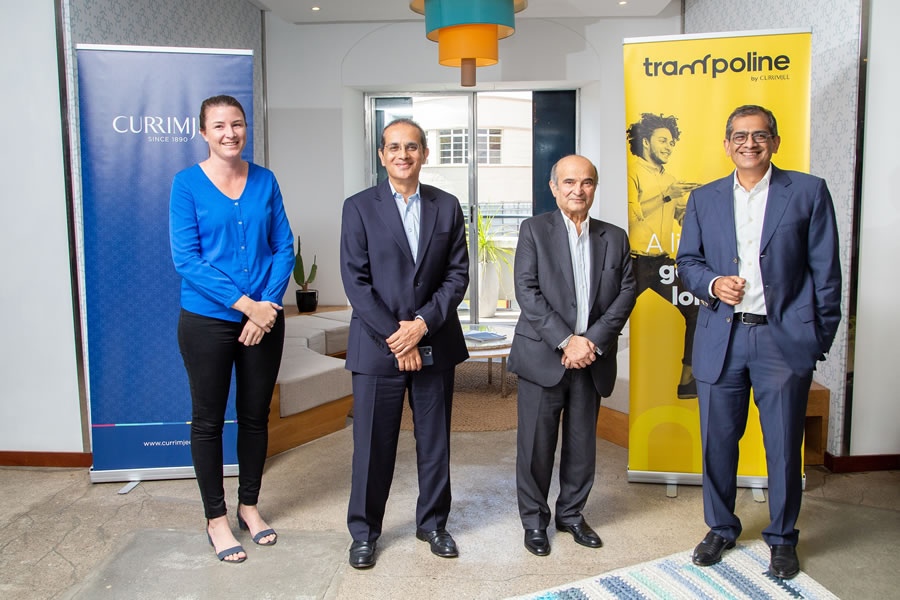
Concluding an international agreement — the Group's consistent model is partnership for capability, retention of local control.

A converged internet and television launch — evidence of the Group's move from infrastructure into consumer services.
Import the Capability. Keep the Control.
Small economies face a recurring dilemma when they need world-class capability. They can wait for a multinational to arrive — which may never happen, because the market is too small to justify the entry cost. They can attempt to build from scratch — which usually produces a domestic champion that is protected, expensive and mediocre. Or they can find a third route.
The Currimjee model has consistently taken the third route: partner internationally for technology, systems and standards, while retaining domestic ownership and long-term decision rights. Global principals contribute engineering, brand, process discipline and access to research. The Group contributes capital, market knowledge, distribution, regulatory navigation and — the scarcest input — a willingness to remain committed through the unprofitable early years.
This structure explains several otherwise puzzling features of the Group. It is why Mauritian consumers have had access to internationally branded products manufactured to global specification rather than local approximations. It is why a telecom operator on a small island has been able to deploy successive network generations broadly in step with far larger markets. And it is why the Group's businesses have generally been able to survive eventual liberalisation — they were built to international standard from the outset, not to the standard a protected monopoly can get away with.
Engineering, systems, brand standards, R&D access and operating methodology.
Capital, market knowledge, distribution reach, regulatory navigation and patience.
The Architecture That Prevents the Obvious Failures
Governance in a family group has one job above all others: to ensure that decisions are taken on their merits rather than on the basis of relationships. Every structural feature described below exists to serve that single objective.
-
A
Separation of ownership and management
The family owns and sets direction through the holding structure. Operating companies are run by professional executives accountable to their own boards. Being a member of the family confers no automatic operating authority.
-
B
Cluster-level boards
Each business cluster has its own governance with directors possessing relevant sector expertise. Telecom, energy and hospitality face entirely different risks; a single central board cannot competently supervise all of them.
-
C
External expertise deliberately imported
Independent directors and senior executives recruited from outside the family and, frequently, from outside Mauritius. The purpose is to introduce challenge into rooms where deference is the natural default.
-
D
Public market discipline where appropriate
The listing of the Group's flagship telecom company on the Stock Exchange of Mauritius imposed continuous disclosure, independent audit, minority shareholder rights and quarterly accountability — a standard that raises expectations across the whole house.
-
E
Capital allocated centrally, earned locally
Clusters compete for the Group's capital on the strength of their proposals. A profitable business does not automatically retain its own cash flow; it may be redeployed to a cluster with a better long-term claim on it.
-
F
Managed generational transition
The entry of successive generations is planned rather than improvised, with expectations of external experience, merit-based progression, and a clear distinction between the rights of an owner and the responsibilities of an executive.
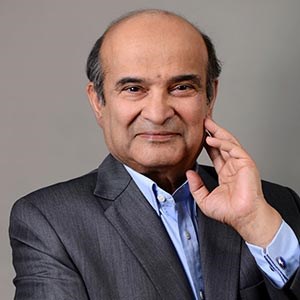
The Chairman — a role defined here as capital allocation, arbitration and the protection of long-horizon commitments.
“If the business needs me in the room to make the right decision, then I have not built the business properly.”Guiding Principle — Bashirali Currimjee
A Note on Scale
The Group employs a substantial workforce across its clusters and is among the significant private sector employers in Mauritius. In an economy this size, employment practice is a matter of public record — every employee is somebody's neighbour, and reputational consequences are immediate.
The Venture That Made the Rest Possible
Every cluster described on this page was financed, directly or indirectly, by the success of one decision taken in 1989. The telecom story deserves to be read in full.